Finance7 min read
UAE e-invoicing rules: what small businesses need to have ready
The UAE's e-invoicing rules, deadlines and penalties explained for small businesses, and the invoicing and accounts tools that make it painless.

Jake GaleaFounder and CEO, Brnded17 ·
- Appoint a service provider, if revenue is under AED 50m
- 31 March 2027
- Go live, if revenue is under AED 50m
- 1 July 2027
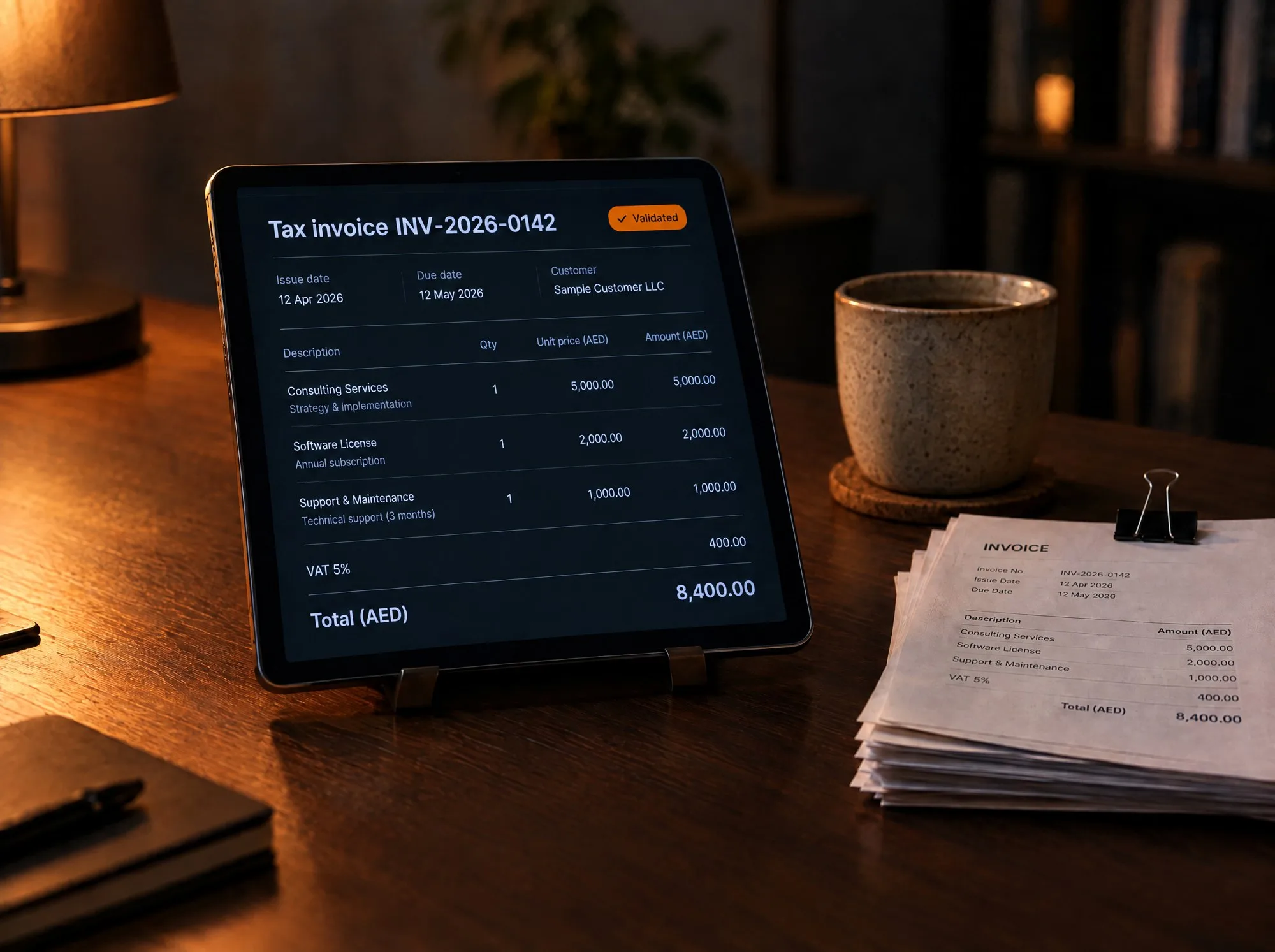
- Mandatory fields on an electronic tax invoice
- 51
- Penalty per month for missing the deadline
- AED 5,000
Key points
- From 1 July 2027, businesses with revenue under AED 50 million must issue invoices to other businesses as structured e-invoices. Larger businesses start on 1 January 2027.
- A PDF sent by email is not an e-invoice. The invoice has to be structured data, sent through an Accredited Service Provider.
- It applies to anyone doing business in the UAE, whether registered for VAT or not. Sales to consumers are excluded for now.
- Your invoicing or accounts system must be able to produce every mandatory field and pass it to your service provider.
The UAE is making electronic invoicing mandatory in stages. If your business has revenue below AED 50 million, you must appoint an Accredited Service Provider by 31 March 2027 and issue e-invoices to other businesses from 1 July 2027. Larger businesses go first, on 1 January 2027.
It is often called “FTA e-invoicing”. Strictly, the rules are set by the Ministry of Finance, and the Federal Tax Authority (FTA) receives the data. Either way, it changes how every business in the country raises an invoice.
This guide covers the rules as they stand on 5 October 2026, what your systems have to do, and the tools Brnded17 can build to make invoicing and keeping your accounts straightforward.
What e-invoicing is, and what it is not
An e-invoice is not a PDF. The Ministry of Finance is explicit that PDFs, Word documents, images, scanned copies and emails are not e-invoices.
An e-invoice is structured data: an XML file in a set format that software can read without a person retyping it. It travels from your system to your customer’s system through approved intermediaries, and a copy of the tax data goes to the FTA at the same moment.
Unlike some countries’ systems, the UAE e-invoice carries no QR code or barcode.
Who it applies to
More businesses than most people assume.
- Anyone doing business in the UAE. The guidelines say it is mandatory “regardless of their VAT registration status”. If you are in scope and have no tax registration, you will need to register with the FTA to get an identifier.
- Business-to-business and business-to-government invoices. These are in scope.
- Sales to consumers are excluded for now. Business-to-consumer transactions stay outside the system until a ministerial decision says otherwise.
- Exports are in scope. Imports from foreign suppliers under the reverse charge are not.
A short list of transactions is excluded, including certain international airline services and some financial services. If you sell only to consumers, check your position with a tax adviser, because the published guidance on receiving e-invoices is not fully settled.
The deadlines
| Who | Appoint a service provider by | Issue e-invoices from |
|---|---|---|
| Pilot and voluntary adoption | Open now | Since 1 July 2026 |
| Revenue of AED 50 million or more | 30 October 2026 | 1 January 2027 |
| Revenue below AED 50 million | 31 March 2027 | 1 July 2027 |
| Government entities | 31 March 2027 | 1 October 2027 |
The 30 October 2026 date was moved from 31 July 2026 by an amendment in May 2026. The Ministry described that as a final adjustment and said the go-live dates would not change.
Revenue here means your gross income in the most recent accounting period, according to your financial statements.
How an e-invoice travels
The UAE uses what it calls a five-corner model. In plain terms:
- You create the invoice in your own system and pass the data to your service provider.
- Your Accredited Service Provider checks it, converts it to the UAE standard format and sends it on.
- Your customer’s service provider receives and checks it.
- Your customer gets the invoice in their system.
- The Federal Tax Authority receives the tax data from the service providers along the way.
You appoint one Accredited Service Provider, and it handles both the invoices you send and the ones you receive. The Ministry of Finance publishes the approved list, which showed 61 accredited providers on 5 October 2026. You start the process through the FTA’s EmaraTax portal.
The format is based on an international standard called Peppol. You do not need to understand it. Your service provider does the converting. What you are responsible for is the accuracy of the data you hand over.
What your invoicing system has to do
This is where preparation pays off. Whatever you use to raise invoices today, whether accounting software, an ERP or a spreadsheet, it must be able to do the following.
- Produce every mandatory field. An electronic tax invoice has 51 of them, and a commercial e-invoice 49. They cover the invoice itself, the seller, the buyer, each line, the tax breakdown and the totals.
- Hold proper customer records. You need each business customer’s legal details, tax registration number and electronic address before you can invoice them.
- Connect to your service provider. Usually through an API, so invoices pass across without anyone exporting files by hand.
- Issue on time. Generally within 14 days of the transaction.
- Handle credit notes. A correction, refund or price reduction is done with an electronic credit note. There is no way to cancel an e-invoice once issued.
- Receive as well as send. Supplier invoices will arrive as data, and your system should be able to take them in.
- Keep the records. E-invoices must be stored and retrievable for the FTA, generally for five years.
A spreadsheet and a Word template cannot do this. If that is how you invoice today, the deadline is also your reason to put a proper system in place.
The penalties
Cabinet Decision No. 106 of 2025 sets out the fines.
| Failure | Penalty |
|---|---|
| Not implementing the system, or not appointing a service provider, on time | AED 5,000 for each month or part of a month |
| Not issuing an e-invoice on time | AED 100 per invoice, up to AED 5,000 a month |
| Not issuing an electronic credit note on time | AED 100 per credit note, up to AED 5,000 a month |
| Not telling the FTA about a system failure within two business days | AED 1,000 for each day or part of a day |
| Not telling your service provider when your registered details change | AED 1,000 for each day or part of a day |
Penalties apply from your mandatory date. Businesses that adopt early are not penalised during the voluntary period.
Keeping the rest of your accounts straight
E-invoicing sits alongside the tax rules you already work with.
- VAT is 5%. Registration is mandatory once taxable supplies and imports exceed AED 375,000 a year, and voluntary from AED 187,500.
- Corporate tax is 9% on taxable income above AED 375,000.
- Small Business Relief is available to eligible businesses with revenue up to AED 3 million, and in July 2026 it was extended to tax periods ending on or before 31 December 2029.
- Records must be kept for five years under the tax procedures rules, and seven years for corporate tax.
Every one of those depends on the same thing: knowing your income and your expenditure accurately, month by month. E-invoicing gets much easier when that is already true.
The tools Brnded17 can build for this
To be clear about our role: Brnded17 is not an Accredited Service Provider and does not give tax advice. We build the systems a business runs on every day, and connect them to the service provider you choose. Here is what that can include.
- Invoicing that is compliant by design. Invoices are raised from the order or job, with every mandatory field filled from your records and checked before anything is sent.
- A direct connection to your service provider. The invoice goes from your system to theirs automatically, and its status comes back: sent, delivered, reported.
- Customer and supplier records. Legal names, tax registration numbers and electronic addresses held once and reused.
- Credit notes and corrections. Raised against the original invoice, so the history stays clean.
- Income and expenditure tracking. Money in, money out and what is still unpaid, on one screen and by month.
- Expense capture. Receipts and supplier bills logged as they arrive, not in a shoebox at year end.
- VAT summaries. What you collected and what you paid, ready for your accountant when the return is due.
- Reminders and reports. Unpaid invoices chased automatically and a monthly summary that writes itself.
We already build the finance side into the systems we deliver. The operations system we built for The Refined Luxury shows revenue and unpaid totals alongside orders and quotes, and the WhizzFix staff system includes a payments log and a finance view.
It can be a small focused tool for invoicing alone, or part of a custom ERP that also runs your orders and stock. If you are unsure which you need, read CRM vs ERP.
A readiness checklist
- Work out which phase you are in. Check your revenue for the last accounting period against the AED 50 million line.
- List how you invoice today. Which software, who does it, and how many invoices a month go to other businesses.
- Check your data. Do you hold a tax registration number and full legal details for every business customer?
- Choose an Accredited Service Provider from the Ministry of Finance list, and ask how it connects to your system.
- Fix or replace your invoicing system so it produces every mandatory field.
- Test before the deadline. Send, receive and correct a few invoices while it is still voluntary.
If step 5 is where you get stuck, that is the part Brnded17 does. We build ERP systems for small businesses in the UAE at a fixed quote, in phases, with invoicing first if that is what the deadline demands.
This article is general information based on documents published by the UAE Ministry of Finance and the Federal Tax Authority up to 5 October 2026. It is not tax or legal advice. Rules can change, so confirm your own position with the Ministry of Finance, the FTA or a registered tax adviser.
Sources (11)
- UAE Ministry of Finance: eInvoicing (official page)
- Ministerial Decision No. 243 of 2025 on the Electronic Invoicing System
- Ministerial Decision No. 244 of 2025 on the implementation of the Electronic Invoicing System
- Ministry of Finance: targeted amendments to eInvoicing decisions (10 May 2026)
- Cabinet Decision No. 106 of 2025 on eInvoicing violations and penalties
- UAE Electronic Invoicing Guidelines, version 1.1 (1 June 2026)
- UAE electronic invoice mandatory fields, version 1.0 (23 February 2026)
- Ministry of Finance: Accredited Service Providers list
- Federal Tax Authority: e-Invoicing
- Federal Tax Authority: registration for VAT
- Ministerial Decision No. 131 of 2026 on Small Business Relief (29 July 2026)