AI6 min read
How to get your business recommended by ChatGPT and Google's AI answers
More buyers now ask an AI assistant before they search. What makes ChatGPT, Gemini and Perplexity name one business, and what we do on our own site.

Jake GaleaFounder and CEO, Brnded17 ·
- People using ChatGPT each week
- 900M+
- Monthly users of Google AI Overviews
- 2.5bn+
- Of AI-cited pages also rank in Google's top 10
- 12%
- Our own Lighthouse SEO score
- 100
Key points
- AI assistants recommend businesses they can read, understand and verify. Most of that is good SEO done thoroughly, not a new trick.
- Put the answer, the price and the place in plain text near the top of the page. Assistants quote what is stated clearly.
- What other sites say about you matters as much as what your own site says: reviews, directories and press.
- Check your robots.txt. Many sites block the AI crawlers without knowing it.
AI assistants recommend the businesses they can read, understand and verify. To be one of them, your website has to be open to their crawlers, state plainly what you do, where and for how much, and be backed up by what other sites say about you.
Most of that is good SEO done thoroughly. This article explains how the assistants choose, the techniques that matter, and exactly what Brnded17 does on its own site, with the scores to show for it.
Why this matters now
Search has a second front door. OpenAI says more than 900 million people use ChatGPT every week. Google says its AI Overviews, the summaries at the top of search results, reach more than 2.5 billion people a month.
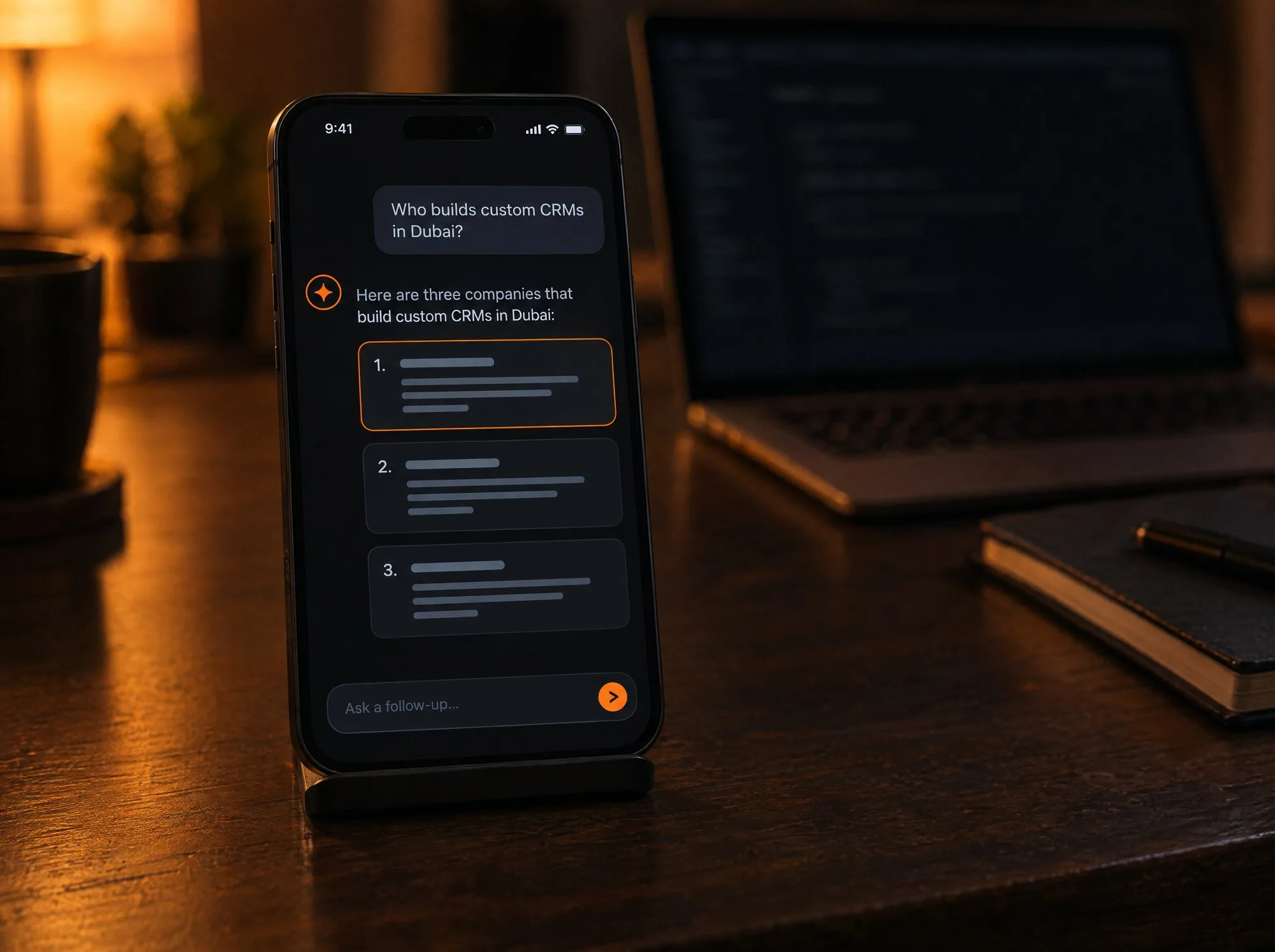
When someone asks an assistant “who builds custom CRMs in Dubai?”, they do not get ten blue links. They get three or four names. If yours is not one of them, you were never in the running.
How AI assistants choose who to name
Assistants answer from two places: what they learned in training, and what they find when they search the live web. For questions about local businesses and prices, the live search does most of the work.
Three findings from recent studies are worth knowing.
- It is not the same list as Google’s top ten. Ahrefs found that only 12% of the pages cited by AI assistants also rank in Google’s top ten for the same question.
- Each assistant has its own favourites. In another Ahrefs study, 86% of the most-cited sources were not shared between ChatGPT, Perplexity and Google’s AI Overviews.
- Your own site matters most for questions about you. Profound found that on brand-specific questions, 54% to 73% of citations go to the brand’s own website, depending on the assistant. Muck Rack found that about 99% of the links AI cites are unpaid, and roughly 27% are journalism.
Put together: you cannot buy your way in, you need to be clear on your own site, and you need to be mentioned elsewhere.
Nine techniques that work
1. Let the crawlers in
Each assistant uses named crawlers, and your robots.txt file decides whether they may read your site.
| Crawler | Who runs it | What it is for |
|---|---|---|
| OAI-SearchBot | OpenAI | Finding pages to show in ChatGPT’s search answers |
| GPTBot | OpenAI | Collecting content that may be used to train models |
| ChatGPT-User | OpenAI | Fetching a page when a user asks ChatGPT to open it |
| PerplexityBot | Perplexity | Finding and linking pages in Perplexity’s answers |
| Googlebot | Google Search, which also feeds AI Overviews and AI Mode | |
| Google-Extended | Controls use in Gemini training and grounding. It does not affect Google Search |
Many sites block these without knowing, through a security plugin or a hosting default. If OAI-SearchBot is blocked, OpenAI says your site will not appear in ChatGPT’s search answers.
2. Be properly indexed in Google first
Google’s guidance is blunt: to appear in AI Overviews or AI Mode, a page must be indexed and eligible to show in Google Search with a snippet, and there are “no additional requirements”. In Google’s words, optimising for generative AI search is “still SEO”.
3. Answer the question in the first two sentences
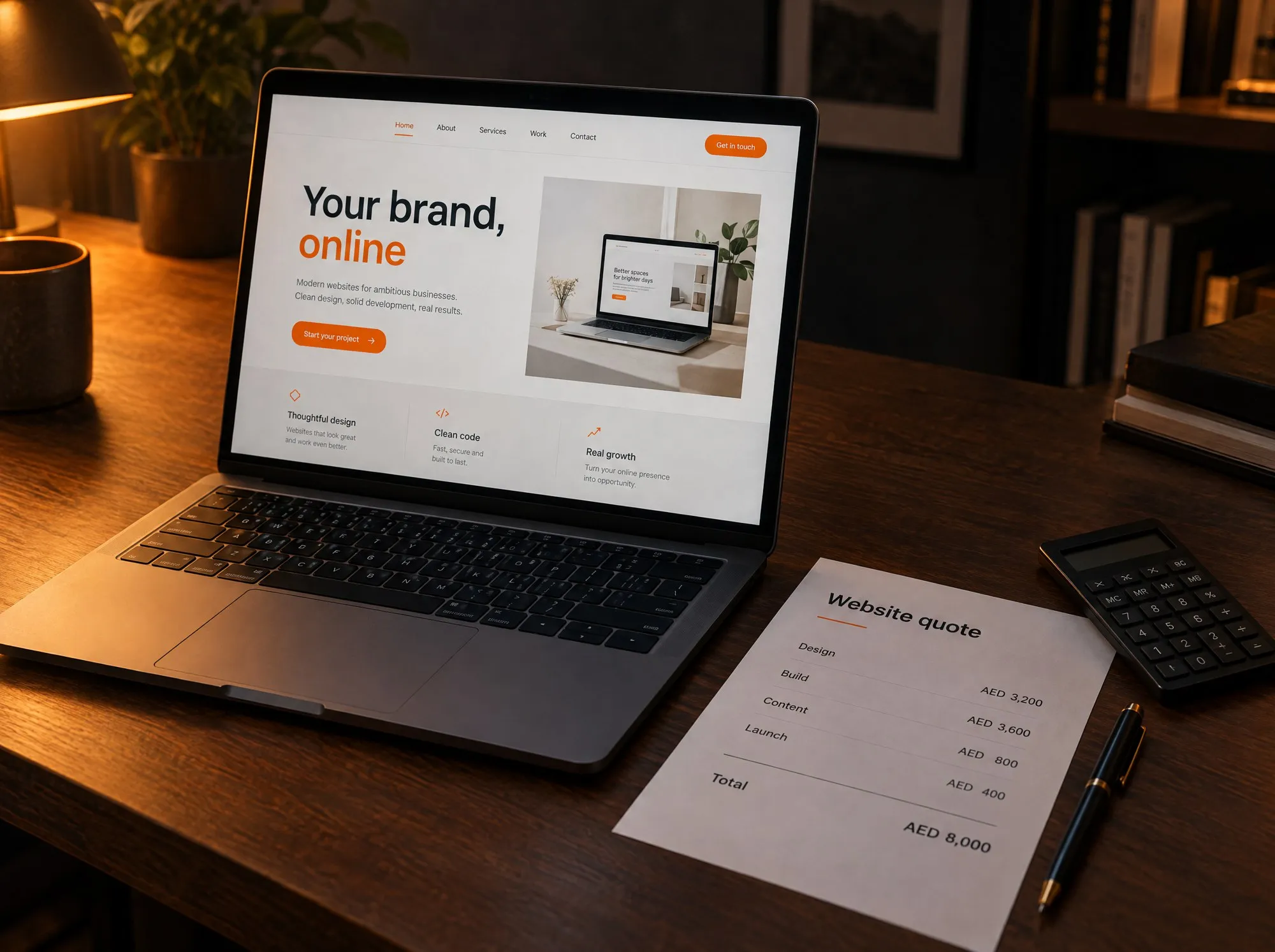
Assistants quote what is stated clearly. Open each page with a direct answer, then explain. “Brand websites start from AED 8,000 and typically launch in 2 to 3 weeks” can be quoted. “We craft bespoke digital experiences” cannot.
4. Put the facts in plain text
Prices, turnaround times, locations, opening hours and what is included. If a fact lives only in an image, a PDF or behind a “contact us for pricing” button, an assistant has nothing to repeat.
5. Add structured data
Structured data is a hidden label on each page that tells machines what it is: this is a business, this is its address, this is a service, this is a question and its answer. It removes the guesswork.
6. Make the page readable without JavaScript
Some crawlers do not run JavaScript. If your content only appears after scripts load, they may see an empty page. Fast, simple HTML is the safest foundation.
7. Say the same thing everywhere
Your name, address, phone number, prices and hours should match on your website, your Google Business Profile, your LinkedIn page and every directory. Contradictions make an assistant less sure of you, and an unsure assistant recommends someone else.
8. Earn mentions on other sites
Reviews, directory listings, client credits and press coverage are what assistants lean on when they compare businesses. This is slower than fixing your own site, and it is the part most competitors skip.
9. Publish facts worth quoting
Original, specific information gets cited: real prices, real timelines, case studies and guides that answer the questions your customers actually ask. That is the reason this blog exists.
What about llms.txt? It is a proposed file that summarises a site for AI systems. Google says it is not needed, and its own search advocate has called it “purely speculative for now”. We publish one because it takes ten minutes. Do everything above first.
What we do on our own site
We build these techniques into every site we make, and brnded17.com is where we test them. Here is what is in place today.
- Open to every major AI crawler. Our robots.txt names and allows the crawlers from OpenAI, Anthropic, Perplexity and Google.
- Answers first. Every service and location page opens with what we do, what it costs and how long it takes.
- Published prices. From AED 8,000 for a website to AED 25,000 for a custom system, in plain text.
- Structured data on every page. Organisation, founder, services, FAQs, breadcrumbs, case studies and articles.
- Readable without JavaScript. Pages are delivered as finished HTML, so every crawler sees the full content.
- A current llms.txt. A plain summary of our services, prices and case studies.
And the scores. We tested three pages of brnded17.com with Google Lighthouse on 5 October 2026, on mobile settings.
| Page | Performance | Accessibility | Best practices | SEO |
|---|---|---|---|---|
| Home | 93 | 100 | 100 | 100 |
| Website services | 100 | 100 | 100 | 100 |
| Our work | 100 | 98 | 100 | 100 |
Each page showed its main content in 1.0 to 1.3 seconds, with no blocking time and almost no layout shift.
Those scores measure the foundation: whether a site is fast, readable and correctly labelled. They are the part you can control and check today. Being named in AI answers follows from that foundation plus the mentions you earn over time, and we apply the same approach for clients through our SEO and technical SEO service.
How to check where you stand
- Ask the assistants. Type the questions your customers would ask into ChatGPT, Gemini and Perplexity. Note who is named and which sources are linked.
- Check your robots.txt. Visit yourdomain.com/robots.txt and look for “Disallow” next to any crawler in the table above.
- Test your pages. Run your home page through Google’s free PageSpeed Insights and Rich Results Test.
- Look at your referrals. In Google Analytics, check whether visits are arriving from chatgpt.com, perplexity.ai or gemini.google.com.
A 30-day plan
- Week 1: Unblock the crawlers, fix indexing problems and make sure every page loads fast on a phone.
- Week 2: Rewrite the top of your key pages to answer first, and put prices, locations and hours in plain text.
- Week 3: Add structured data, and bring your Google Business Profile and directory listings into line with your site.
- Week 4: Ask three happy customers for a Google review, and publish one page that answers a question buyers really ask.
If you would rather have it done for you, Brnded17 offers a technical SEO audit in Dubai that covers Google and AI search together, quoted at a fixed price before we start.
Sources (13)
- OpenAI: more than 900 million weekly ChatGPT users (27 February 2026)
- Google: AI Overviews has over 2.5 billion monthly users (19 May 2026)
- Google Search Central: AI features and your website
- Google Search Central: optimising for generative AI features (July 2026)
- OpenAI: overview of OpenAI crawlers
- Perplexity: Perplexity crawlers
- Google: common crawlers, including Google-Extended (July 2026)
- Ahrefs: only 12% of AI-cited URLs rank in Google's top 10 (August 2025)
- Ahrefs: top-mentioned sources are not shared across AI assistants (June 2025)
- Muck Rack: What is AI reading? (May 2026)
- Profound: citation categories across AI platforms (January 2026)
- Search Engine Journal: Google says llms.txt is purely speculative for now (June 2026)
- llms.txt proposal